How a Video Podcast Can Help Grow Your Fitness Business

What if the conversations you already have with gym members, training clients, and online followers could become content that keeps working after the conversation ends?
A video podcast can help a fitness business explain its expertise, introduce prospective customers to its people, and create material for YouTube, Instagram, a website, and online offers. It doesn't have to become a separate media empire. For many businesses, the better goal is a manageable, recurring source of useful content.
But before investing in a podcast, gym owners deserve a better argument than 'everyone listens to podcasts.' The more relevant questions are who listens to health and fitness content, whether those audiences resemble your customers, and how video can make production more valuable.
Who Actually Listens to Health and Fitness Podcasts?
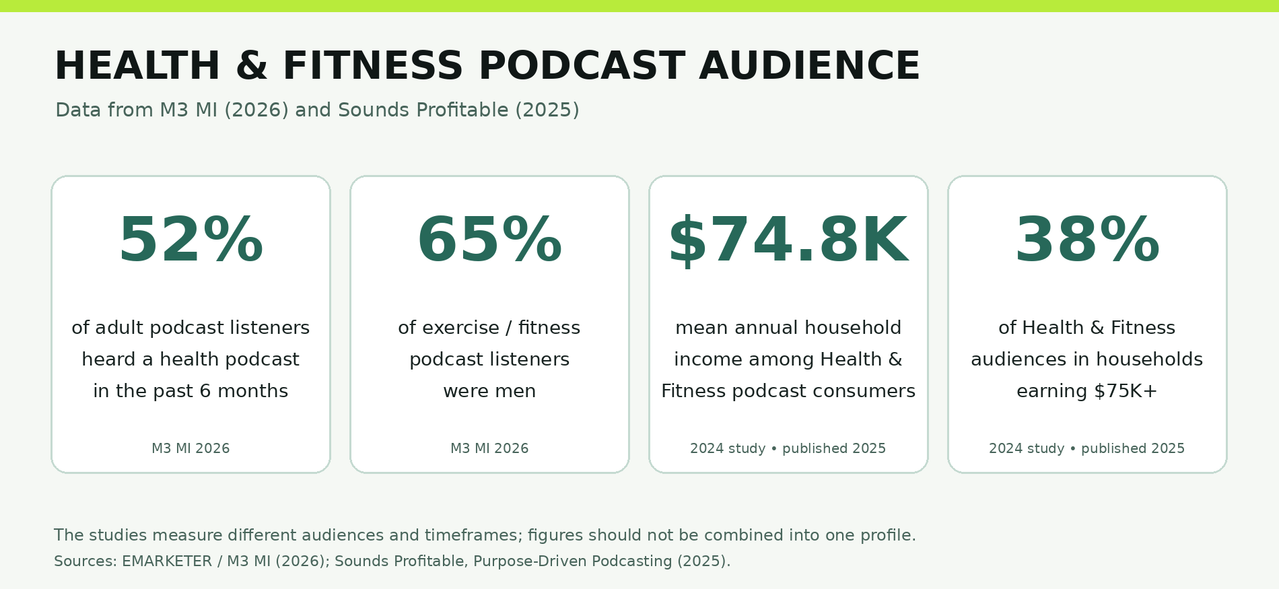
A 2026 M3 MI MARS Consumer Health survey, summarized by EMARKETER found that 52% of U.S. adult podcast listeners had consumed a health-related podcast in the previous six months. Individual categories—including exercise and fitness, nutrition, mental health, and specific health conditions—each reached roughly 21% to 27% of podcast listeners.
The audience differs by topic. In that same survey, nearly two-thirds of health podcast listeners were Millennials or Gen Z. Exercise-and-fitness podcasts in the survey had a 65% male / 35% female listener split. That doesn't describe every fitness podcast; an older-adult wellness show, a women's strength-training program, and a bodybuilding interview show can attract very different audiences.
The takeaway for a trainer isn't to chase a national average. It's to choose topics that match the people you want to serve, then use the podcast's own analytics and inquiries to refine the strategy.
What About Household Income and Buying Power?
The 2025 Sounds Profitable / SiriusXM Purpose-Driven Podcasting report, using its 2024 Podcast Landscape research, reported a $74,817 mean annual household income among Health & Fitness podcast consumers. It also reported that 38% came from households earning at least $75,000 a year. In that dataset, 40% were ages 35–54 and 27% were 55 or older.
Those figures use a different sample and a different year than the 2026 M3 MI survey. The average is a mean, not a median. We should not treat the two reports as one combined demographic profile—or claim that a listener's income guarantees a purchase.
For fitness businesses, the useful point is that health-and-fitness podcasting is not limited to one age group or budget. Depending on the subject, a show can introduce both local gym memberships and higher-involvement offers such as specialized coaching or an online training library.
Video Podcasts Are Growing—and YouTube Matters
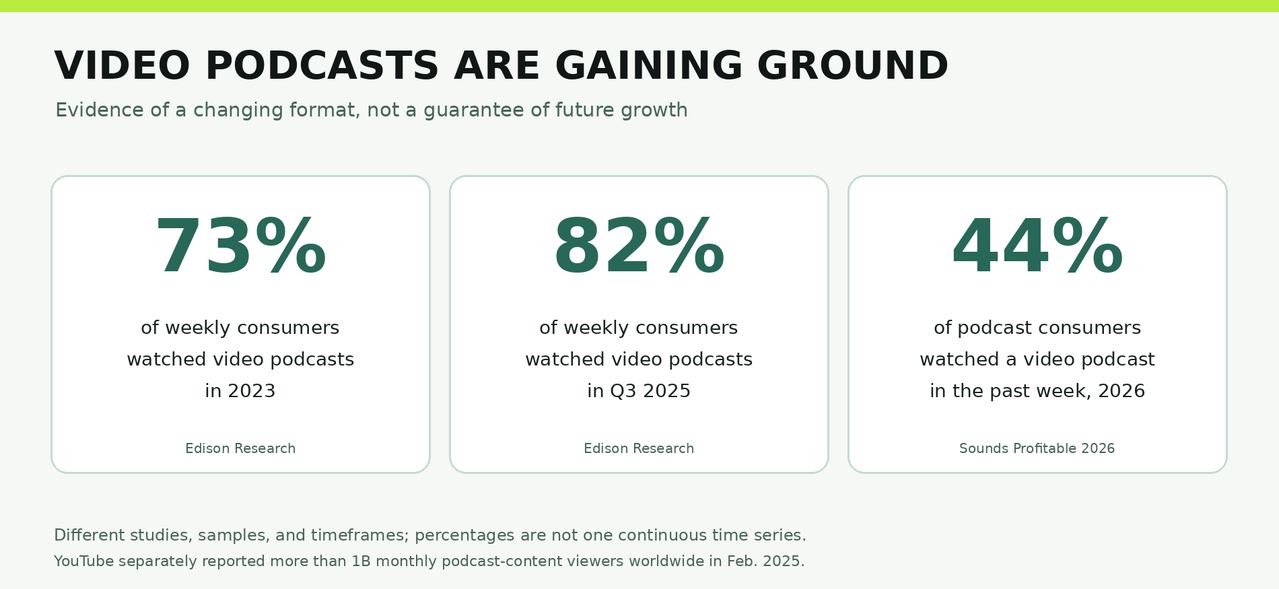
According to Edison Research’s The Podcast Consumer 2026, the share of weekly podcast consumers who watched video podcasts rose from 73% in 2023 to 82% in Q3 2025. During Q3 2025, watching video podcasts (82%) briefly exceeded listening to audio-only podcasts (78%) among weekly podcast consumers, and the formats remained close afterward.
More recently, Sounds Profitable’s October 2026 Podcast Landscape reported that 44% of podcast consumers watched a video podcast in the previous week, compared with 40% in the prior year. This is a separate study and measure, not an extension of Edison's 73%-to-82% series.
YouTube is an important part of that shift. In February 2025, YouTube announced more than one billion monthly viewers of podcast content worldwide. That is a global YouTube audience, not a projection of how many customers any one Denver gym will reach.
Together, the findings suggest a practical direction: video is likely to remain an increasingly important part of podcast distribution. For fitness brands, recording video at the beginning can provide more marketing options than recording audio alone. Audio still matters, particularly when people listen while driving, exercising, or doing chores.
How a Podcast Can Introduce New Customers to Your Fitness Products
A fitness show works best when it starts with questions a potential customer already has. What does a beginner need to know before joining a gym? How does a trainer choose an exercise progression? What should someone look for when selecting an online program?
Useful episodes can make a trainer's approach familiar before a person ever walks into the facility or books a consultation. When it fits the conversation, the host can point to a relevant next step: a gym tour, personal training, online coaching, a subscription video library, a digital workout plan, or an e-book.
For instance, an episode on beginner weightlifting could finish by offering a free introductory consultation for Denver viewers and linking to a more extensive online workout library for people outside Colorado. The podcast introduces the approach; the service or digital product provides deeper instruction.
The key is relevance. A podcast is not a guaranteed sales funnel, and an informative episode shouldn't become a continuous commercial. Give the viewer useful information first, then offer a clear next step.
Why Record Video First Instead of Producing Separate Videos?
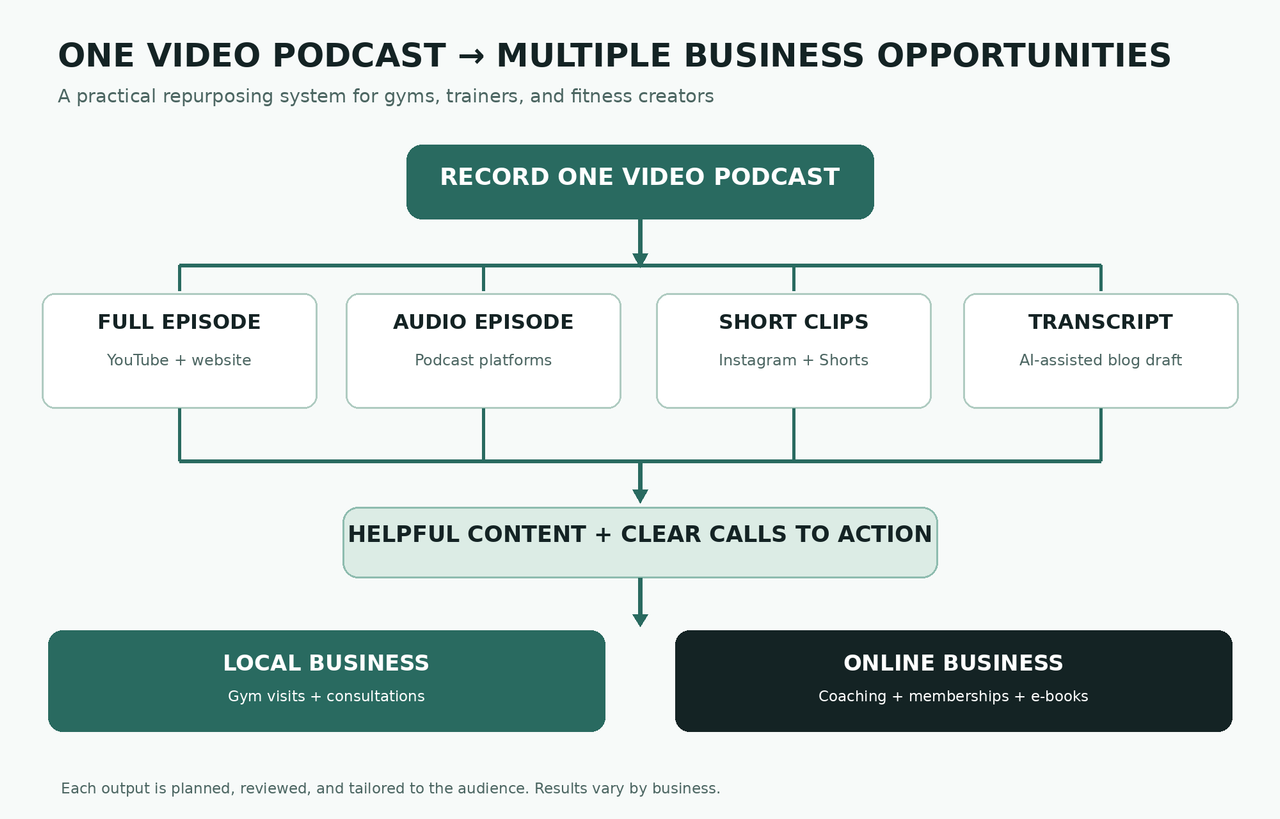
Video-first recording captures a conversation once and provides material that can be adapted for several destinations. A full episode can live on an existing YouTube channel; its audio can be distributed to podcast platforms; well-chosen excerpts can become Instagram Reels and YouTube Shorts.
You do not automatically need a second YouTube channel. A gym can organize its main channel with separate playlists for podcast conversations, exercise demonstrations, member stories, and trainer introductions. That way a viewer who discovers one topic can find more of the business's educational material.
Fitness is a visual subject. On-camera explanations, demonstrations, and member conversations can add context that audio alone may not provide. But it's still worth keeping audio options available for listeners who prefer them.
One Recording, Multiple Pieces of Useful Content
Imagine a trainer recording an episode titled Five Mistakes Beginners Make When Building Muscle. That conversation could become a full-length YouTube episode, an audio podcast, several short educational excerpts, a newsletter highlight, and a website article.
Each version has a different job. The full episode explains the subject in detail. Short clips introduce the idea to new viewers. The website article answers a search question. A relevant link can direct interested people to a gym consultation or an online training program.
The flowchart below illustrates the system. It isn't a promise that every episode will produce a fixed number of clips or sales. The objective is to plan a few useful outputs rather than create more content for its own sake.
Turn Your Podcast Transcript Into an AI-Assisted Blog
This may be one of the most overlooked advantages for gym owners: a podcast can also supply original source material for an educational article on your website.
After the recording, generate a transcript. An AI tool can organize the conversation into sections, suggest headings, and create a first draft. Then a human editor—ideally the trainer or an appropriately qualified reviewer—needs to verify claims, add useful examples, correct awkward language, and make sure the article accurately represents what was said.
A podcast titled Five Mistakes Beginners Make When Building Muscle might become a blog titled Five Common Muscle-Building Mistakes and How to Avoid Them. Include an embedded episode when the website allows it, relevant internal links, and a useful invitation to explore the training program.
This matters for SEO, but AI text by itself is not an SEO shortcut. Google’s guidance on generative-AI content says AI can help structure original material while emphasizing accuracy, quality, relevance, and manual review. A mass of lightly edited articles is not a substitute for answering real customers' questions well.
How Podcast-Based Articles Can Support Your Website
Publishing informative articles gives your website more opportunities to answer specific searches. A Denver gym might write about how to prepare for a first personal-training consultation, how its coaches explain strength progressions, or what to expect when joining a new facility.
A local visitor might use that article to learn about the gym and book a visit. Someone in another state might explore the online membership or digital training library instead. Link the article to relevant services and make it easy for readers to contact the business.
Good articles can support search discovery and visitor confidence, but rankings depend on many factors. Posting transcripts does not automatically increase rankings or improve Google Maps placement.
Your Podcast Can Serve Local Members and Online Customers
Consider a Denver training facility that publishes a conversation about strength training for beginners. A nearby viewer may want to visit the facility, meet the coach, and explore a membership. A viewer in another state may prefer an online training program, an exercise video library, or a downloadable e-book.
One episode can address both audiences, but the call to action should distinguish between them: Visit our Denver gym for local services; Explore our online programs if you train from somewhere else. The website should make both routes clear.
A Recurring Production Partner Makes the Process More Manageable
The hardest part for many fitness business owners isn't finding something worthwhile to say. It's setting aside time for camera setup, audio, lighting, filming, editing, and deliverables while still running the business.
A production partner can take on the agreed technical work, help plan a practical recording schedule, and deliver a predictable set of assets. The client brings the subject expertise and knows the business. The production team handles the filming and editing described in the agreement.
For regular content, a monthly retainer can create a more dependable system: one agreed monthly price, an agreed production schedule, and a defined set of deliverables. The topics evolve, while the scope and expectations stay clear. This is a manageable recurring service—not an assumption that unlimited filming, editing, publishing, or high-volume batching is included.
Measure the Business Outcomes, Not Just the Views
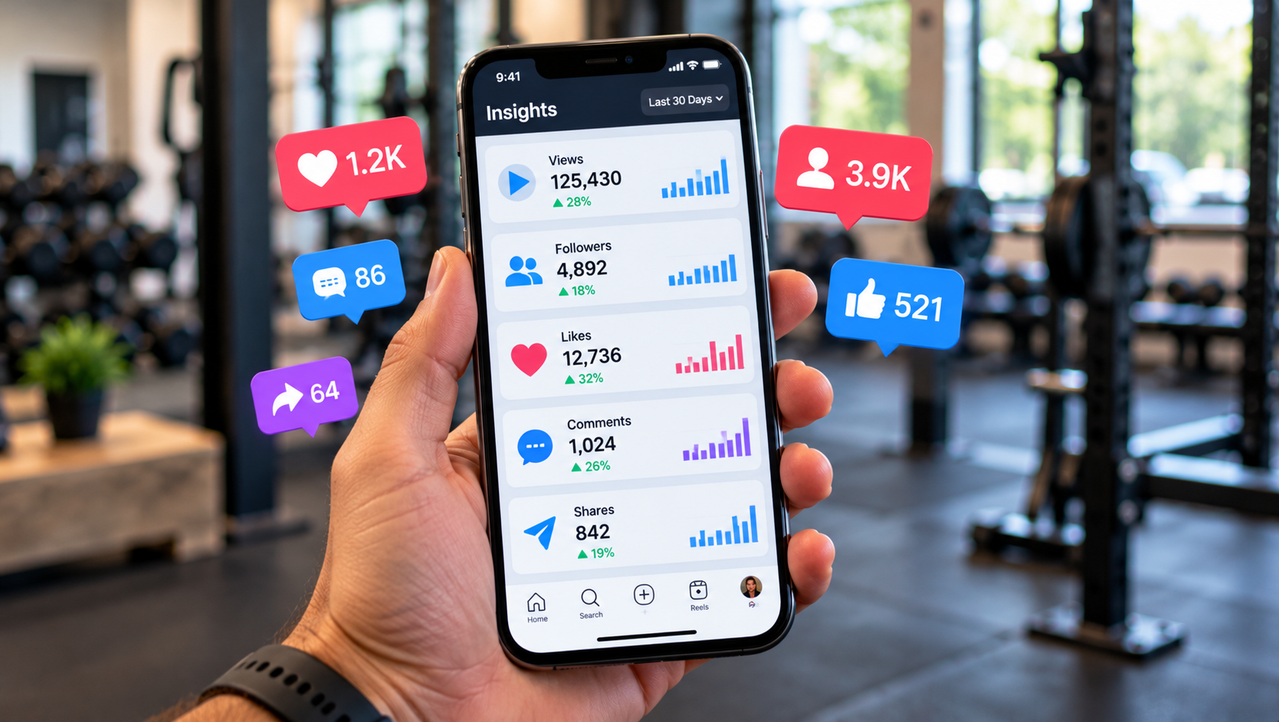
Views, downloads, and followers are useful indicators, but they aren't the whole story. Pay attention to website visits, consultation requests, gym tours, online membership sign-ups, digital product purchases, and the questions new prospects ask.
Use dedicated links when possible, and ask new clients how they discovered the gym. A modest show that reaches the right prospective customers can be more valuable than a popular clip that attracts no relevant inquiries.
Let Fitness Media Productions Handle Your Content Production
Running a gym, coaching clients, and growing a fitness business takes time. Producing consistent, professional content shouldn't turn into another full-time job.
At Fitness Media Productions, we work with gyms, personal trainers, fitness creators, and wellness businesses on recurring photo and video production. Our monthly retainer arrangements are built around one agreed price, a consistent production schedule, and defined monthly deliverables.
We come to your location, manage the agreed filming and editing, and deliver content according to the production plan. Whether you're launching a video podcast, building a YouTube library, or creating short-form content, we can discuss a recurring package that matches your goals and budget.
You focus on running your business. We'll focus on producing your content.